

Forget what politicians say. What truly matters is what they do, and what they do is vote, to write the laws that affect us all. That idea is why we built They Vote For You: so anyone can look up how their representatives actually vote.
But there is a catch we have always lived with. We can only show you the votes Parliament records, and we have just measured how much that leaves out.
When a question is put to the House or the Senate, it can be settled two ways. In a division, members are counted and every name goes on the record. That is what They Vote For You is built from. Or it can be decided on the voices: the presiding officer listens to the “ayes” and “noes” called out, judges which is louder, and declares the result. No count. No names. No record of how anyone voted, or even of who was in the room.
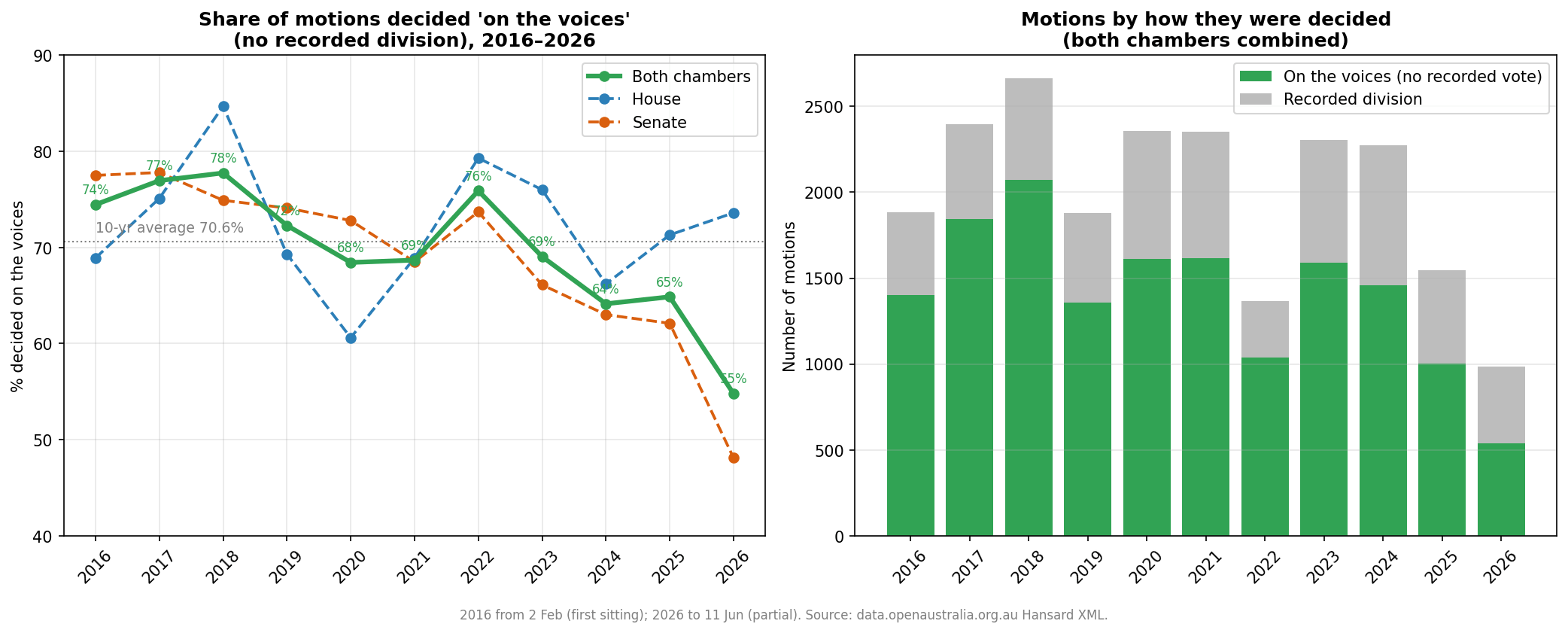
We went through the official Hansard record for every sitting day in both chambers, from the start of 2016 to June 2026, and counted how each motion was decided.
Across that decade, Parliament decided 22,008 motions. Just 6,475 went to a recorded division. The other 15,533, just over 70 per cent, were decided on the voices, with no record of how anyone voted. The pattern holds in both chambers: 71.8 per cent in the House and 70.0 per cent in the Senate.
For roughly seven in ten decisions our Parliament makes, there is no public record of who supported them.
We have seen what this gap costs before. When advertising claimed that teal independents vote with the Greens more than 70 per cent of the time, we found the claim could only ever rest on division data, because the rest of the record does not exist. For most decisions, there is simply nothing to check a claim against.
To be fair, much of this is routine and uncontested, and counting every motion would waste time the chambers do not have. The share has also been slowly falling over the decade, and this is not about any one party; the practice spans every Parliament in our data.
But seventy per cent is a great deal of democracy happening off the record. The rules that decide when a vote is recorded were shaped long before a result could be online and searchable within minutes. The technology has moved on. The threshold has not.
It is worth revisiting. Other legislatures use electronic voting that captures every member’s position in seconds. A lower bar for a recorded vote would mean anything of real public interest is captured by default. Neither slows Parliament down. Both put more of what our representatives decide where people can see it.
If you think the decisions made in your name belong on the record, this is a change worth backing. Tell your local member you want recorded votes to be the norm, not the exception.
You can explore what is on the record at They Vote For You, and the data behind this post is open for anyone to check.
Divisions are counted exactly; on-the-voices decisions are careful estimates drawn from the wording of Hansard. Source: openaustralia.org.au hansard records between 2 February 2016 to 11 June 2026.